The Aging Pattern That Keeps You From Becoming a Legacent
Moving In
There is a strange thing that can happen after 60. You have more to draw from than you have ever had before. You have stories, skills, mistakes, successes, people you have known, places you have been, things you have learned the hard way, and things you now value that took decades to see clearly. You have lived through transitions because of change that once seemed impossible. You have watched people and institutions develop and decline. You have adapted, recovered, reinvented yourself, and kept going. And yet, somewhere along the way, a quiet question can surface: What am I going to do with all of this?
That question is especially meaningful for many mentors, coaches, facilitators, and dedicated learners. Professionals, managers, and leaders also experience this when they use adult education tools.You have spent much of your life gathering experience and giving it away. You taught classes, led teams, built programs, guided people through difficult moments, sat beside someone who was struggling, and asked questions that shifted a person's direction. You may have spent forty or fifty years becoming the person others came to when they needed perspective.
Then something SHIFTS.
The title disappears. Someone new is taking over the office. The organization moves forward. Technology shifts language. Younger people arrive with different expectations. Your calendar becomes quieter.And suddenly, some of the things that made you valuable seem harder to see.
For All of US
Aging shifts position. It does not erase contribution.
That distinction may be one of the most important things to understand_value about life after 60.
We think of aging primarily in terms of what happens to us. Our bodies change. Our roles change. Our relationships change. Our circumstances change. Those things matter. Yet there is another dimension of aging that receives far less attention.
What happens to everything we have accumulated inside us?
That may be the deeper question.
Because experience does not automatically become wisdom. Wisdom does not automatically become something another person can use. And a lifetime of knowledge does not automatically become a wisdom-based legacy.There is a pattern that can quietly keep us from making that transition.We keep collecting when we need to start curating.
We read another book. Take another course. Save another article. Attend another conference. Learn another system. Add another credential. Capture another idea. For people like us, learning is part of who we are. Curiosity has probably carried us through much of our lives.
The question course corrects, though, as the years accumulate.
Instead of asking, “What else should I learn?” we can begin asking, “What deserves to stay?”
That is a curation question.
After decades of learning, perhaps the task is less about adding to the pile and more about sorting through it. What still matters? What changed me? What have I learned that someone else might need? What have I learned too late? What do I wish someone had told me thirty years ago?
These questions can feel surprisingly personal.
Curation asks us to look at our lives differently. We begin to see that our experiences are more than memories. Some contain patterns. Some contain principles. Some contain warnings. Some contain practices. Some contain stories that could save another person years of confusion.
And some of our most valuable lessons may be hiding inside experiences we have almost forgotten.
The difficult conversation.The failed project.The student who changed our thinking.The person we mentored who eventually surpassed us.The decision we got wrong.The moment when something finally became clear after years of trying to understand it.This is where our experience becomes interesting.
For You
Your most valuable wisdom may be hiding inside the experiences you almost forgot.
You can keep your wisdom until you are ready to share it. However:
I have met many people over the years who carry an extraordinary amount of knowledge.When I ask them a question, they take a lifetime to answer.A story leads to another story. An experience connects to a lesson.Something that happened twenty-five years ago suddenly explains something happening today.
There is a richness there. Yet richness alone is difficult to transfer.
A person cannot inherit everything you know simply because you know it. They need something they can see, value, practice, question, adapt, and eventually make their own.
That is where mentoring becomes so important.
Mentoring is more than giving insights.
You can gain experience without having to go through all the same mistakes.
For an adult educator over 60, this can become a remarkable next chapter.
You do not have to recreate your former career.
You do not have to become an online personality.
You do not have to build a huge audience.
You may simply need to ask a different question:
What part of my experience is ready to become useful to someone else?
That question can change how you look at your own history.
Suddenly, the past becomes a resource.
Your career becomes a collection of lessons.
Your relationships become a source of insight.
Your failures become mentoring material.
Your questions become invitations for someone else's thinking.
Your accumulated experience has somewhere to go.
And yet,
You wait too long to turn experience into contribution.
You tell yourself that someday you will write the book.
Someday you will organize the stories.
Someday you will mentor more intentionally.
Someday you will create the course.
Someday you will pass along what we have learned.
Someday is a comfortable place.
It allows you to feel that your contribution is still ahead of you.
Yet there comes a point in life when the work pivots.
Earlier in life, you are often building your life.
Later, you have an opportunity to shape what your life to educate us.
That is a very different kind of work.
Your next chapter may require less accumulation and more distillation.
This is where the idea of becoming a Legacent begins.
A Legacent is not simply an older person with a lifetime of experience.
A Legacent is someone who shapes and shares that experience so it continues through other persons.
The movement is simple:
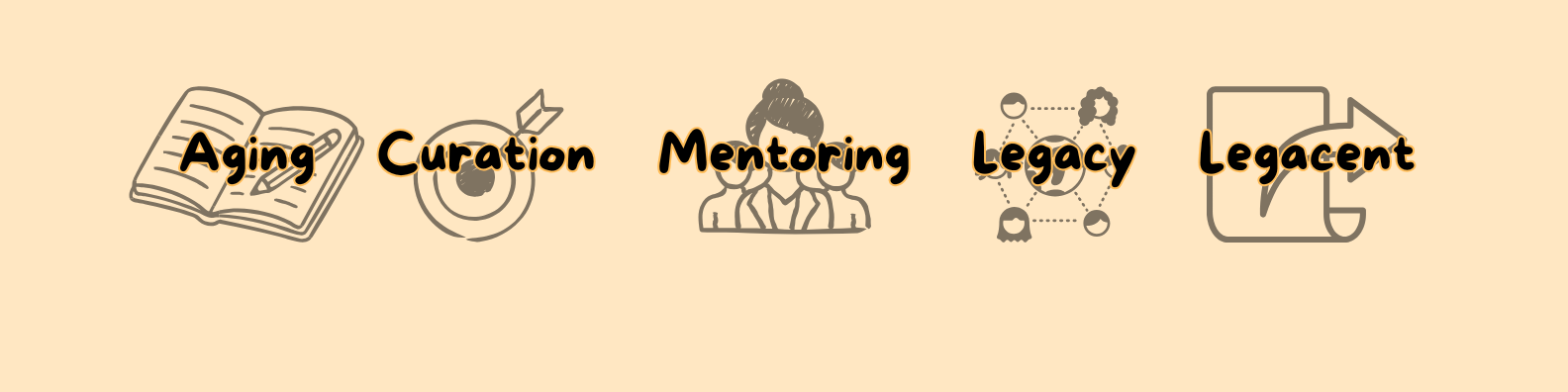
Aging gives us experience.
Curation gives that experience structure.
Mentoring makes it transferable.
Legacy gives it continuity.
Becoming a Legacent gives it direction.
Seen this way, becoming a Legacent is less about leaving something behind and more about making something available.
That distinction matters.
Leaving something behind can sound final. Almost like closing a book.
Making something available feels alive.
Your story becomes available.
Your questions become available.
Your practices become available.
Your hard-earned lessons become available.
Your way of seeing becomes available.
Someone else takes what you have shaped and does something you could never have predicted.
That may be one of the most satisfying possibilities of growing older.
You stop asking, “How much more can I accomplish?”
And begin asking, “What can I make easier for someone coming after me?”
You stop asking, “What else do I need to learn?”
And begin asking, “What do I already know that deserves a second life?”
You stop measuring your relevance by how many people need you.
And begin measuring your contribution by what can continue without you standing in the room.
That is a profound shift for educators, and those who use education tools and techniques.
Because education has always been about more than information.
At its best, education is about transfer. More so, about meeting something that matters!
One generation learns something, shapes it, tests it, questions it, improves it, and offers it forward.
For All of US
Perhaps this is one of the great opportunities of aging.
We can move from being primarily collectors of knowledge to becoming curators of experience.
We can move from having wisdom to making wisdom usable.
We can move from asking what comes next for us to asking what can move forward through us.
A legacy happens when experience becomes useful beyond the person who lived it.
This is the heart of becoming a Legacent.
It is a shift from accumulation to curation.
From curation to mentoring.
From mentoring to legacy.
And from legacy to something that encourages the lives of others.
Moving Forward
The aging pattern that keeps us from becoming Legacents may therefore be surprisingly ordinary.
We keep thinking our next chapter requires something new from us.
Perhaps it requires something deeper.
Perhaps the next chapter begins when we turn around and look at what is already there.
The experiences.
The lessons.
The failures.
The breakthroughs.
The people.
The questions.
The wisdom we earned slowly.
Then we begin the work of deciding what is worth carrying forward.
That is where aging becomes more than getting older.
That is where experience becomes contribution.
And that is where a lifetime can become Legacent.
A Gift:
Here is this I-progression for persons:
Intend
Inquire
Insight
Invite
Impact
Here is this I-progression for people:
Intend
Invite
Insight
Inquire
Impact
Begin Your Legacy Conversation
Your experience carries stories, lessons, and insights that deserve to be explored.
A Legacy Conversation helps you reflect on your journey, curate what matters, and discover how your lived experience can become a meaningful contribution.
In 55 minutes, we will explore your aging journey, your defining experiences, your mentoring potential, and the legacy you want to continue creating.
You receive a recorded conversation, video, and transcript to help you reflect on what emerges.
Start your Legacy Conversation today — and discover what your experience is ready to contribute.
Create Your Legacent Map
Your experience contains patterns, possibilities, and pathways waiting to be mapped.
A Legacent Map Making Conversation helps you transform decades of lived experience into a practical contribution map using the MAKES MAPPS framework.
In 90 minutes, you will begin mapping your knowledge, actions, engagements, stories, and future pathways.
You receive your personalized map, video recording, and transcript as a foundation for your next contribution.
Create your Legacent Map today — and explore tomorrow through what you already know.
Consider this strategic distinction between the two offers:
Legacy Conversation = Discover what matters. More here
Legacent Map Making = Design what comes next. More here
Together, they create a natural pathway:
Aging → Curation → Mentoring → Legacy → Legacent
The first helps You understand your story.
The second helps You draft the map that turns your story into contribution.
Comments are appreciated_ What questions-comments would you like to share? What can we improve, focus and/or strengthen with this article?
When you provide your email--it is for us to chat about your message--we will NOT add you to any list. Period!


To receive email updates on additions to the Blog
place the word BLOG in the comments. That simple!
You'll receive emails about the Blog ONLY!
Also, you can ask questions - share a comment - pass along a funny.
An Invitation to Becoming a Legacent Arriving in this season I've never
One Year, Three Legacents Moving In In October 2025, I sat with
Legacy After 60: The First Aid of Living Legacy with Clarity, Caring,
Legacy After 60: The First Aid of Living Legacy with Clarity, Caring,
Welcome to Legacent_the online magazine weaving the topics legacy, experience, education, safety,
The Matrix Growing One Tree, One Intention, One Legacy Metaphorical story A